
Somewhere between a factory in Basel and a bedside in Bengaluru, a vaccine can die and no one notices — until a patient doesn’t respond to a dose that was never really “alive” to begin with. That is the quiet, unglamorous crisis running underneath the world’s medicine supply.
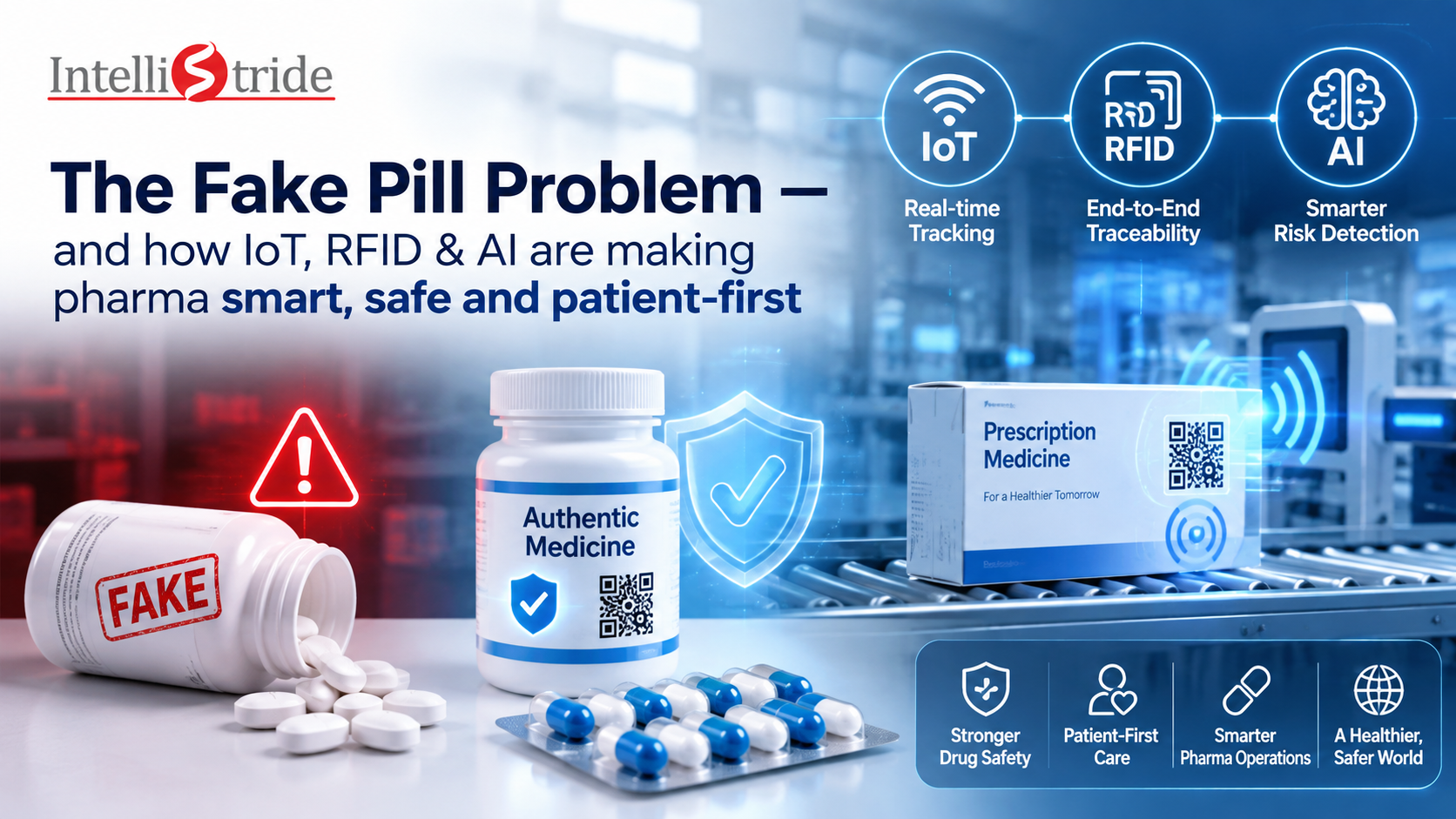
Counterfeit drugs, broken cold chains and blind spots that stretch across oceans aren’t a fringe problem — they’re a trillion-dollar shadow industry operating in the same shipping lanes as legitimate pharma. For years, the tools to fight it lagged behind the tools used to exploit it. That’s changing. IoT, RFID and AI are becoming the nervous system, the identity layer and the brain of modern pharmaceutical supply chains — and the shift is redefining what “smart medicine” actually means.
- ~50%of counterfeit goods seized worldwide are fake medicines
- 1 in 10medical products in low- & middle-income countries are substandard or falsified — WHO
- 20%efficiency gain reported after AI-led production scheduling
01 · THE PROBLEM
Pain points with a global price tag
Picture a real scenario that played out repeatedly during the pandemic: authentic COVID-19 test kits are intercepted in transit, swapped for convincing fakes, and shipped onward — with no visible difference on the outside of the box. That single point of failure can ripple into misdiagnoses, delayed treatment and eroded trust in public health systems, all from one broken link in a chain that spans continents.
Counterfeiting is only half the story. Cold chain failure is the other. Vaccines and biologics are engineered to survive within tight temperature windows — often just a few degrees either side of ideal. A refrigeration unit that drifts during a customs delay, a truck that loses power on a hot tarmac, a warehouse with an ambient swing overnight — any of these can silently degrade a shipment’s efficacy long before anyone opens the box. Industry estimates put global cold-chain-related pharma losses in the billions of dollars annually, before counting the human cost of a patient receiving a dose that no longer works.
Every additional handoff in a global pharma supply chain is another opportunity for tampering, temperature excursions, diversion or paperwork fraud.
Layer on top of this the sheer geography of modern pharma — active ingredients sourced from one continent, manufactured on another, distributed across dozens of regulatory jurisdictions — and the exposure compounds. Regulators from the FDA to the EMA to India’s CDSCO have all tightened serialization and track-and-trace mandates in response, but mandates alone don’t close the gap. Technology does.
Nowhere is this more visible than across the Asia-Pacific region, which manufactures a significant share of the world’s active pharmaceutical ingredients and generic medicines, and now moves that output through some of the most demanding climates and infrastructure gaps on the planet. India in particular sits at the center of this story as the “pharmacy of the world” — a major exporter of generics and vaccines to over 200 countries — which means any weakness in its cold chain or track-and-trace systems doesn’t stay local; it travels outward with every shipment.
02 · THE SENSES
IoT: real-time eyes on every shipment
If a modern pharma supply chain has a nervous system, IoT sensors are the nerve endings. Deployed inside pallets, containers and cold storage units, they continuously monitor temperature, humidity and light exposure and transmit real-time alerts the moment a shipment drifts outside its safe range. That single capability — knowing about a problem in minutes instead of discovering it weeks later at the point of use — is what turns a potential write-off into a recoverable shipment.
03 · THE BRAIN
AI: from raw data to proactive decisions
Sensor data is only valuable if something intelligent acts on it, and that’s where AI earns its place in the stack. Where IoT tells you what is happening, AI tells you what’s likely to happen next — and what to do about it. Predictive analytics models forecast demand at a granular, market-by-market level, helping manufacturers hold the right inventory instead of over- or under-producing critical medicines.
Anomaly detection models go further, flagging patterns a human reviewer would likely miss: a shipment taking an unusual route, a delivery arriving hours later than its logged departure would allow, a batch of “identical” scans that are suspiciously too perfect. Those are the digital fingerprints of tampering and diversion, and AI is often the first system to notice them.
04 · THE IDENTITY
RFID: the security layer counterfeiters can’t fake
If IoT is the senses and AI is the brain, RFID is the identity card every single package carries. RFID tagging enables mass serialization — a unique, trackable identifier on every unit, not just every batch — which is what makes true end-to-end track-and-trace possible instead of a best-effort approximation. That same tagging turns inventory cycle counts, traditionally a slow, error-prone manual process, into an automated scan that takes minutes and catches discrepancies humans routinely miss.
But RFID’s biggest evolution is happening at the security layer. Many of today’s lightweight RFID protocols were built for cost and battery efficiency, not cryptographic strength — leaving them exposed to cloning and tag-disclosure attacks. The next generation is shifting toward Authenticated Encryption protocols engineered specifically for the limited processing power of a drug package’s tag, giving pharma companies serious cryptographic protection without asking a low-cost tag to do a data-center’s worth of computing — and hardware simulations confirm it’s achievable within the strict resource constraints medical devices demand.
05 · WHAT’S NEXT
Smart, patient-centric pharma
Put IoT, AI and RFID together and the endpoint isn’t just a more secure supply chain — it’s a more human one. Smart packaging embedded with QR codes or NFC tags is already giving patients instant, phone-tap access to dosage instructions, interaction warnings and authenticity verification — closing the gap between “the medicine arrived safely” and “the patient actually takes it correctly.” That single shift meaningfully improves medication adherence, particularly for chronic and complex regimens.
From bulk shipments to patient-specific delivery
This same connected infrastructure is what makes on-demand, patient-specific distribution realistic — smaller, more frequent, condition-specific shipments instead of one-size-fits-all bulk distribution.
Verified medicine that actually arrives
For patients in remote or underserved regions across Southeast Asia, Africa and South Asia, this shift could be the difference between medicine that’s theoretically available and medicine that reliably arrives, verified and intact.
The pharmaceutical industry has always measured success in outcomes. IoT, RFID and AI are simply extending that measurement all the way back through the supply chain — so that by the time a medicine reaches a patient, its entire journey has already been verified, monitored and protected. That’s not a future state. It’s already being built, one connected shipment at a time.